Hypothetical situation here: let’s say you bought an iPhone or iPad,
but cheaped out and got a 16GB model. You’ve got around 10GB worth of
music, a few gigs in photos and applications, and you lose the rest to
formatting and the OS itself. Basically, you’re maxed on capacity.
Day-to-day, this isn’t a huge issue, but let’s say you’re going on
vacation and want to have some movies to watch so that you can avoid the
customary in-flight chick flick [or replace with whatever type of
movies you dislike]. HD movies aren’t storage friendly, they take a
solid chunk of storage space, and you don’t want gut your portable music
library for the sake of watching a couple of decent movies on the
plane. So what do you do?
Fret not, there is now a solution to that dilemma by way of Kingston and Seagate, among others. Both have recently launched wireless storage devices, streaming your media files to up to three mobile devices via WiFi. Now, both of these are non-ideal solutions to a relatively marginal problem, but that’s to be expected in any newly conceived market. With the shift to cloud-based data and media streaming for mobile devices, there is going to be a gradual de-emphasizing of device storage. We’re already seeing that in a big way with Google’s Cloud OS and Apple’s iCloud service, so wireless storage technologies are going to play an important role in handling media streaming for the future. The two devices we’re looking at today are pricey and aren’t perfect by any means, but they point the way to what the future of local media storage might look like.

Seagate’s GoFlex Satellite builds off the storage giant’s expertise in hard drives by creating a wireless media streamer based on a portable hard drive. It looks like a larger version of the company’s GoFlex hard drives, albeit with a power switch and an AC adapter input port, and ships in a 500GB configuration with a 5400RPM 2.5" drive inside. Compared to the standard 500GB GoFlex drive, the Satellite is 50% thicker and adds about a half inch to the length and a quarter inch to the width. Interestingly, we noticed a 10mm difference between the listed length dimension and what I measured (130mm versus the 120mm figure quoted in the specsheet). Either way, it’s bigger than the typical 2.5” external drive, but the Satellite shares the same enclosure as the as the 1TB and 1.5TB GoFlex drives, which have thicker hard drives than their lower-capacity brethren.
Fret not, there is now a solution to that dilemma by way of Kingston and Seagate, among others. Both have recently launched wireless storage devices, streaming your media files to up to three mobile devices via WiFi. Now, both of these are non-ideal solutions to a relatively marginal problem, but that’s to be expected in any newly conceived market. With the shift to cloud-based data and media streaming for mobile devices, there is going to be a gradual de-emphasizing of device storage. We’re already seeing that in a big way with Google’s Cloud OS and Apple’s iCloud service, so wireless storage technologies are going to play an important role in handling media streaming for the future. The two devices we’re looking at today are pricey and aren’t perfect by any means, but they point the way to what the future of local media storage might look like.
Device Hardware
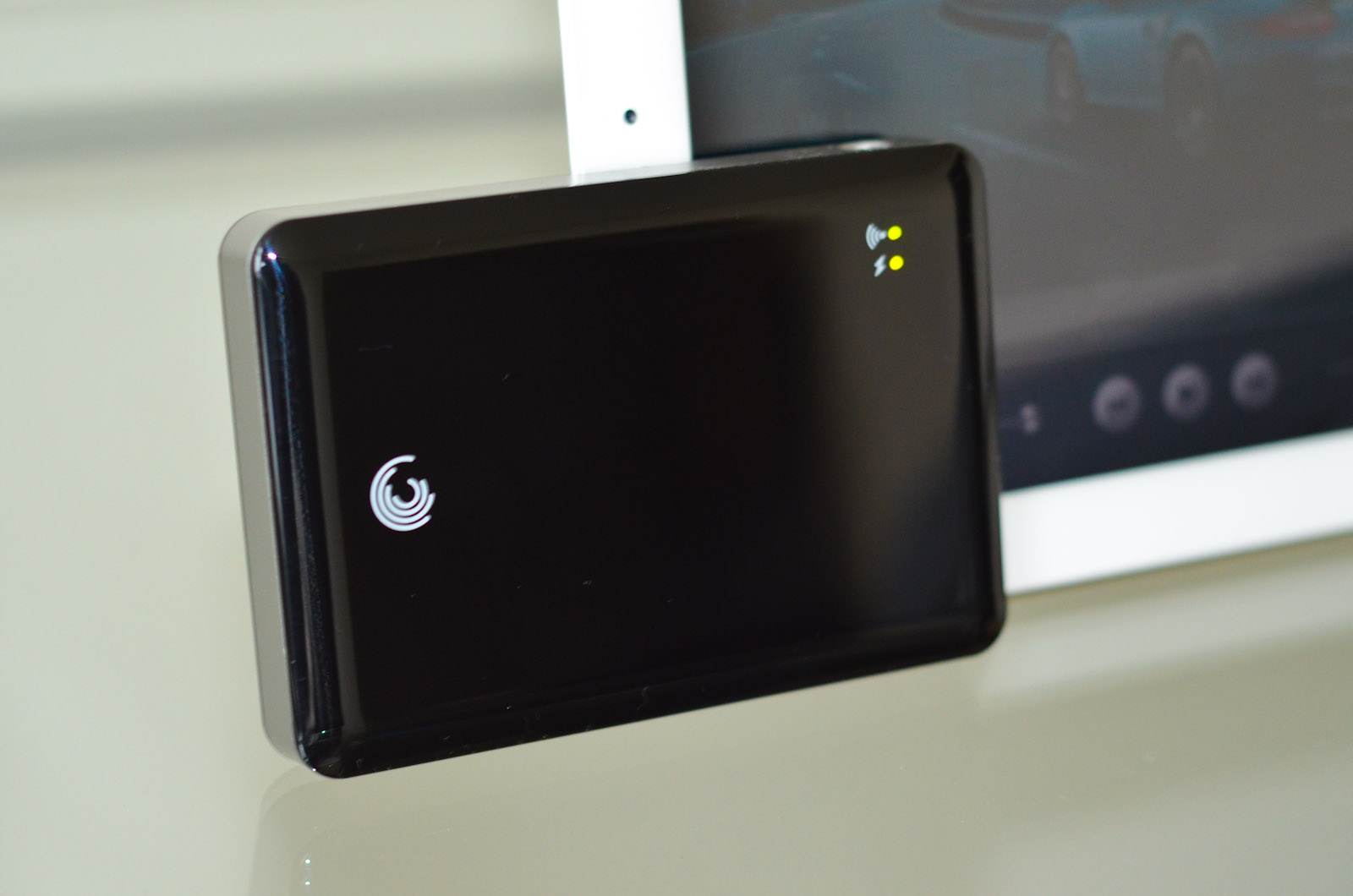
Seagate’s GoFlex Satellite builds off the storage giant’s expertise in hard drives by creating a wireless media streamer based on a portable hard drive. It looks like a larger version of the company’s GoFlex hard drives, albeit with a power switch and an AC adapter input port, and ships in a 500GB configuration with a 5400RPM 2.5" drive inside. Compared to the standard 500GB GoFlex drive, the Satellite is 50% thicker and adds about a half inch to the length and a quarter inch to the width. Interestingly, we noticed a 10mm difference between the listed length dimension and what I measured (130mm versus the 120mm figure quoted in the specsheet). Either way, it’s bigger than the typical 2.5” external drive, but the Satellite shares the same enclosure as the as the 1TB and 1.5TB GoFlex drives, which have thicker hard drives than their lower-capacity brethren.

