search for it

Showing posts with label AMD. Show all posts

Friday, June 26, 2015

Best Graphics Cards For The Money: June 2015 (VGA Chart)


What about this other card that’s not on the list? How do I know if it’s a good deal or not? This will happen. In fact, because inventory levels and prices change quickly, it’s guaranteed to happen. So how do you know if that card you’ve got your eye on is a good buy in its price range? Here is a resource to help you judge if a card is a good buy or not. The graphics card hierarchy chart groups graphics cards with similar overall performance levels into tiers. The top tier contains the highest-performing cards available, and performance decreases as you go down the tiers from there. You can use this hierarchy to compare the pricing between two cards, to see which one is a better deal, and also to determine if an upgrade is worthwhile. I don’t recommend upgrading your graphics card unless the replacement card is at least three tiers higher. 

Otherwise, the upgrade is somewhat parallel, and you may not even notice any worthwhile difference in performance. At the request of readers, we've added mobile graphics and integrated chipsets to the hierarchy chart. We want to make it clear that there is very little performance data available for these graphics solutions. While the discrete video cards in the chart are placed in tiers based on a lot of information, many of the mobile and integrated devices in the chart are guesstimates based on their specifications. 

At worst, we doubt they’re more than one tier away from their actual performance, but this is something to keep in mind when considering mobile graphics chipsets. - See more at: http://www.tomshardware.com/reviews/gaming-graphics-card-review,3107-7.html#sthash.eumLyC7g.dpuf


Graphics Card Hierarchy Chart
GeForce Radeon Intel
Discrete: GTX Titan Z Discrete: R9 295X2
Discrete: GTX 690, Titan X, 980 Ti Discrete: HD 7990
Discrete: GTX 780 Ti, 980, Titan Black
Discrete: GTX 780, 970, Titan Discrete: R9 290, 290X, 390X, 390
Discrete: GTX 590, 680, 770 Discrete:  HD 6990, 7970 GHz Ed, R9 280X, 380
Go (mobile): 980M
Discrete: GTX 580, GTX 670, GTX 960 Discrete: HD 5970, 7870 LE (XT), 7950, 280, 285
Go (mobile): 970M
Discrete: GTX 660 Ti, GTX 760 Discrete: HD 7870, R9 270, R9 270X, R7 370
Go (mobile): 880M
Discrete: GTX 295, 480, 570, 660 Discrete: HD 4870 X2, 6970, 7850, R7 265,
Go (mobile): 680M, 780M Mobility: 7970M
Discrete: GTX 470, 560 Ti, 560 Ti 448 Core, 650 Ti Boost, 750 Ti Discrete: HD 4850 X2, 5870, 6950, R7 260X
Mobility: 7950M
Discrete: GTX 560, 650 Ti, 750 Discrete: HD 5850, 6870, 7790
Go (mobile): 580M, 675M Mobility: 6990M
Discrete: 9800 GX2, 285, 460 256-bit, 465 Discrete: HD 6850, 7770, R7 260, R7 360
Mobility: 6900M
Discrete: GTX 260, 275, 280, 460 192-bit, 460 SE, 550 Ti, 560 SE, GT 650, GT 740 GDDR5 Discrete: HD 4870, 5770, 4890, 5830, 6770, 6790, 7750 (GDDR5), R7 250 (GDDR5), R7 250E Iris Pro Graphics 6200
Go (mobile): 570M, 670M Mobility: HD 5870, 6800M
Discrete: 8800 Ultra, 9800 GTX, 9800 GTX+, GTS 250, GTS 450  Discrete: HD 3870 X2, 4850, 5750, 6750, 7750 (DDR3), R7 250 (DDR3)
Go (mobile): 560M, 660M Mobility: HD 4850, 5850, 7870M
Discrete: 8800 GTX, 8800 GTS 512 MB, GT 545 (GDDR5), GT 730 64-bit GDDR5 Discrete: HD 4770
Go (mobile): GTX 280M, 285M, 555M (GDDR5) Mobility: HD 4860, 7770M, 7850M
Discrete: 8800 GT 512 MB, 9800 GT, GT 545 (DDR3), GT 640 (DDR3), GT 740 DDR3 Discrete: HD 4830, HD 5670, HD 6670 (GDDR5), HD 7730 (GDDR5)
Go (mobile): 9800M GTX, GTX 260M (112), GTS 360M (GDDR5), 555M (DDR3) Mobility: HD 5770, HD 5750, 6600M/6700M (GDDR5), 7750M
Discrete: 8800 GTS 640 MB, 9600 GT, GT 240 (GDDR5) Discrete: HD 2900 XT, HD 3870, HD 5570 (GDDR5), HD 6570 (GDDR5)
Go (mobile): 9800M GTS, GTX 160M Mobility: 6500M (GDDR5), 6600M/6700M (DDR3), 7730M
Discrete: 8800 GS, 9600 GSO, GT 240 (DDR3) Discrete: HD 3850 512 MB, HD 4670, HD 5570 (DDR3), HD 6570 (DDR3), HD 6670 (DDR3), HD 7730 (DDR3), R7 240
Go (mobile): GTX 260M (96), GTS 150M, GTS 360M (DDR3) Mobility: HD 3870, HD 5730, HD 5650, 6500M (DDR3)
Discrete: 8800 GT 256 MB, 8800 GTS 320 MB, GT 440 GDDR5, GT 630 GDDR5, GT 730 128-bit GDDR5 Discrete: HD 2900 PRO, HD 3850 256 MB, 5550 (GDDR5)
Go (mobile): 8800M Mobility: HD 3850
Discrete: 7950 GX2, GT 440 DDR3, GT 630 DDR3, GT 730 128-bit DDR3 Discrete: X1950 XTX, HD 4650 (DDR3), 5550 (DDR3)
Integrated: HD 7660D
Discrete: 7800 GTX 512, 7900 GTO, 7900 GTX, GT 430, GT 530 Discrete: X1900 XT, X1950 XT, X1900 XTX 
Go (mobile): 550M
Discrete: 7800 GTX, 7900 GT, 7950 G, GT 220 (DDR3) Discrete: X1800 XT, X1900 AIW, X1900 GT, X1950 Pro, HD 2900 GT, HD 5550 (DDR2)
Go (mobile): 525M, 540M Integrated: HD 7560D
Discrete: 7800 GT, 7900 GS, 8600 GTS, 9500 GT (GDDR3), GT 220 (DDR2) Discrete: X1800 XL, X1950 GT, HD 4650 (DDR2), HD 6450, R5 230
Go (mobile): 7950 GTX Mobility: X1800 XT, HD 4650, HD 5165, 6400M
Integrated: HD 6620G, 6550D, 7540D
Discrete: 6800 Ultra, 7600 GT, 7800 GS, 8600 GS, 8600 GT (GDDR3), 9500 GT (DDR2)  Discrete: X800 XT (& PE), X850 XT (& PE), X1650 XT, X1800 GTO, HD 2600 XT, HD 3650 (DDR3), HD 3670 Integrated: Intel HD Graphics 4000
Go (mobile): 7800 GTX, 7900 GTX Mobility: X1900, 3670 
Integrated: 6520G, 6530D, 7480D
Discrete: 6800 GT, 6800 GS (PCIe), 8600 GT (DDR2), GT 520 Discrete: X800 XL, X800 GTO2/GTO16, HD 2600 Pro, HD 3650 (DDR2), 
Go (mobile): 7800, Go 7900 GS, 520M, 520MX Mobility: X800 XT, HD 2600 XT, 3650 
Integrated: 6410D, 6480G
Discrete: 6800 GS (AGP) Discrete: X800 GTO 256 MB, X800 PRO, X850 Pro, X1650 GT
Go (mobile): 6800 Ultra, 7600 GT, 8600M GT, 8700M GT, 410M Mobility: HD 2600 
Integrated: 6370D, 6380G
Discrete: 6800, 7300 GT GDDR3, 7600 GS, 8600M GS  Discrete: X800, X800 GTO 128 MB, X1600 XT, X1650 Pro
Go (mobile): 6800, 7700 Mobility: X1800, HD 5145, HD 5470 (GDDR5)
Discrete: 6600 GT, 6800LE, 6800 XT, 7300 GT (DDR2), 8500 GT, 9400 GT  Discrete: 9800 XT, X700 PRO, X800 GT, X800 SE, X1300 XT, X1600 PRO, HD 2400 XT, HD 4350, HD 4550, HD 5450 Integrated: Intel HD Graphics 3000
Go (mobile): 7600 (128-bit) Mobility: X800, 3470, HD 5470 (DDR3), HD 5450, HD 5430, 6300M
Integrated: HD 6310, HD 6320
Discrete: FX 5900, FX 5900 Ultra, FX 5950 Ultra, 6600 (128-bit) Discrete: 9700, 9700 Pro, 9800, 9800 Pro, X700, X1300 Pro, X1550, HD 2400 Pro
Go (mobile): 6800 (128-bit) Mobility: X1450, X1600, X1700, 2400 XT, X2500, 3450
Integrated: 9300, 9400 Integrated: HD 3200, HD 3300, HD 4200, HD 4250, HD 4290, HD 6250, HD 6290 
Discrete: FX 5800 Ultra, FX 5900 XT Discrete: 9500 Pro, 9600 XT, 9800 Pro (128-bit), X600 XT, X1050 (128-bit) Integrated: Intel HD Graphics (Core i5-6x1), 2000
Go (mobile): 6600, Go 7600 (64-bit) Mobility: 9800, X700, X1350, X1400, X2300, HD 2400
Discrete: 4 Ti 4600, 4 Ti 4800, FX 5700 Ultra, 6200, 8300, 8400 G, G 210, G 310 Discrete: 9600 PRO, 9800 LE, X600 PRO, HD 2300 Integrated: Intel HD Graphics (Core i3 5x0, Core i5-6x0)
Go (mobile): 315M Mobility: 9700 (128-bit), X600, X1300
Integrated: Xpress 1250
Discrete: 4 Ti4200, 4 Ti4400, 4 Ti4800 SE, FX 5600 Ultra, FX 5700, 6600 (64-bit), 7300 GS, 8400M GS, 9300M G, 9300M GS Discrete: 9500, 9550, 9600, X300, X1050 (64-bit)  Integrated: Intel HD Graphics (Pentium G)
Mobility: 9600
Discrete: 3 Ti500, FX 5200 Ultra, FX 5600, FX 5700 LE, 6200 TC, 6600 LE, 7200 GS, 7300 LE Discrete: 8500, 9100, 9000 PRO, 9600 LE, X300 SE, X1150 Integrated: GMA X4500
Go (mobile): 5700, 8200M, 9200M GS, 9100 Mobility 9700 (64-bit)
Integrated: 8200, 8300
Discrete: 3, 3 Ti200, FX 5200 (128-bit), FX 5500,  Discrete: 9000, 9200, 9250
Go (mobile): 5600, 6200, 6400, 7200, 7300, 7400 (64-bit) Mobility: 9600 (64-bit), X300
Discrete: FX 5200 (64 bit) Discrete: 9200 SE Integrated: GMA X3000, X3100, X3500
Go (mobile): 7200, 7400 (32-bit) Integrated: Xpress 200M, Xpress 1000, Xpress 1150
Integrated: 6100, 6150, 7025, 7050
Discrete: 2 GTS, 4 MX 440, 2 Ultra, 2 Ti, 2 Ti 200 Discrete: 7500 Integrated: GMA 3000, 3100
Discrete: 256, 2 MX 200, 4 MX 420, 2 MX 400 Discrete: SDR, LE, DDR, 7000, 7200 Integrated: GMA 500, 900, 950
Discrete: Nvidia TNT Discrete: Rage 128 Discrete: Intel 740


Now all that’s left to do is compare performance to your budget, and you'll be able to confidently decide which board is right for you - we even put in the legwork to help find you the best prices! - See more at: http://www.tomshardware.com/reviews/gaming-graphics-card-review,3107-7.html#sthash.eumLyC7g.dpuf

Source: Tom's Hardware

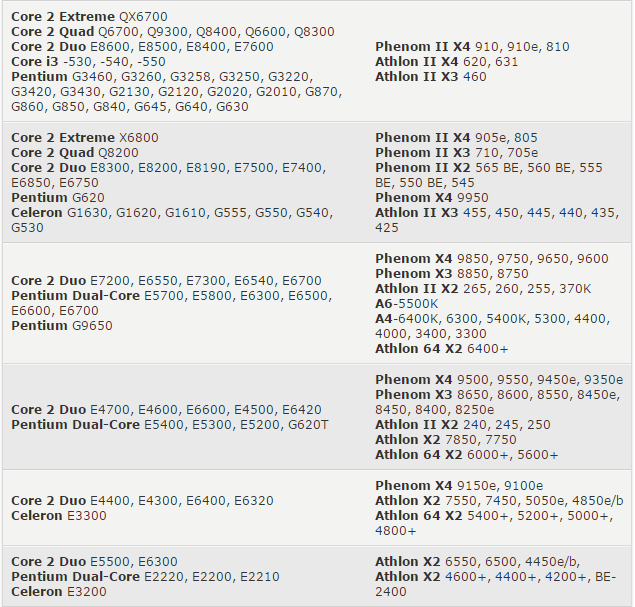
Best Gaming CPUs For The Money: June 2015 (CPUs Hierarchy Chart / Processors Hierarchy Chart)

What about this other CPU that’s not on the list? How do I know if it’s a good deal or not?
This will happen. In fact, it’s guaranteed to happen because availability and prices change quickly. So how do you know if that CPU you have your eye on is a good buy in its price range?
Here is a resource to help you judge if a CPU is a reasonable value or not: the gaming CPU hierarchy chart, which groups CPUs with similar overall gaming performance levels into tiers. The top tier contains the highest-performing gaming CPUs available and gaming performance decreases as you go down the tiers from there.
This hierarchy was originally based on the average performance each CPU achieved in our test suite. We have since incorporated new game data into our criteria, but it should be known that any specific game title will likely perform differently depending on its unique programming. Some games, for example, will be severely graphics subsystem-limited, while others may react positively to more CPU cores, larger amounts of CPU cache, or even a specific architecture. We also did not have access to every CPU on the market, so some of the CPU performance estimates are based on the numbers similar architectures deliver. Indeed, this hierarchy chart is useful as a general guideline, but certainly not as a one-size-fits-all CPU comparison resource. For that, we recommend you check out our CPU Performance Charts.
- See more at: http://www.tomshardware.com/reviews/gaming-cpu-review-overclock,3106-5.html#sthash.69bkXp0H.dpuf

You can use this hierarchy to compare the pricing between two processors, to see which one is a better deal, and also to determine if an upgrade is worthwhile. I don’t recommend upgrading your CPU unless the potential replacement is at least three tiers higher. Otherwise, the upgrade is somewhat parallel and you may not notice a worthwhile difference in game performance. - See more at: http://www.tomshardware.com/reviews/gaming-cpu-review-overclock,3106-5.html#sthash.69bkXp0H.dpuf


Summary
There you have it folks: the best gaming CPUs for the money this month. Now all that’s left to do is compare their performance to your budget before you decide which one is right for you. We even put in the work to help find the best prices.
Also remember that the stores don’t follow this list. Things will change over the course of the month and you’ll probably have to adapt your buying strategy to deal with fluctuating prices. Good luck!
- See more at: http://www.tomshardware.com/reviews/gaming-cpu-review-overclock,3106-5.html#sthash.69bkXp0H.dpuf

Source: Tom's Hardware

List CPUs: Core i7-2600, -2600K, -2700K, -3770, -3770K, -3820, -3930K, -3960X, -3970X, -4770, -4770K, -4790K, -5775C, -5820K, 5930K, -5960X, Core i7-965, -975 Extreme, -980X Extreme, -990X Extreme, Core i5-5675C, -4690K, 4670K, -4590, -4670, -4570, -4430, -3570K, -3570, -3550, -3470, -3450P, -3450, -3350P, -3330, 2550K, -2500K, -2500, -2450P, -2400, -2380P, -2320, -2310, -2300, Core i7-980, -970, -960, Core i7-870, -875K, Core i3-4370, -4170, -4160, -3250, -3245, -3240, -3225, -3220, -3210, -2100, -2105, -2120, -2125, -2130 FX-9590, 9370, 8370, 8350, 8320, 8150, 6350, 4350, Phenom II X6 1100T BE, 1090T BE, Phenom II X4 Black Edition 980, 975, Core i7-860, -920, -930, -940, -950, Core i5-3220T, -750, -760, -2405S, -2400S, Core 2 Extreme QX9775, QX9770, QX9650, Core 2 Quad Q9650, FX-8120, 8320e, 8370e, 6200, 6300, 4170, 4300, Phenom II X6 1075T, Phenom II X4 Black Edition 970, 965, 955 , A10-6800K, 6790K, 6700, 5800K, -5700, -7800, -7850K, A8-3850, -3870K, -5600K, 6600K, -7600, -7650K, Athlon X4 651K, 645, 641, 640, 740, 750K, 860K, Core 2 Extreme QX6850, QX6800, Core 2 Quad Q9550, Q9450, Q9400, Core i5-650, -655K, -660, -661, -670, -680, Core i3-2100T, -2120T, FX-6100, -4100, -4130, Phenom II X6 1055T, 1045T, Phenom II X4 945, 940, 920, Phenom II X3 Black Edition 720, 740, A8-5500, 6500, A6-3650, -3670K, -7400K, Athlon II X4 635, 630, Core 2 Extreme QX6700, Core 2 Quad Q6700, Q9300, Q8400, Q6600, Q8300, Core 2 Duo E8600, E8500, E8400, E7600, Core i3 -530, -540, -550, Pentium G3460, G3260, G3258, G3250, G3220, G3420, G3430, G2130, G2120, G2020, G2010, G870, G860, G850, G840, G645, G640, G630,Phenom II X4 910, 910e, 810, Athlon II X4 620, 631, Athlon II X3 460, Core 2 Extreme X6800, Core 2 Quad Q8200, Core 2 Duo E8300, E8200, E8190, E7500, E7400, E6850, E6750, Pentium G620, Celeron G1630, G1620, G1610, G555, G550, G540, G530, Phenom II X4 905e, 805, Phenom II X3 710, 705e, Phenom II X2 565 BE, 560 BE, 555 BE, 550 BE, 545, Phenom X4 9950, Athlon II X3 455, 450, 445, 440, 435, 425, Core 2 Duo E7200, E6550, E7300, E6540, E6700, Pentium Dual-Core E5700, E5800, E6300, E6500, E6600, E6700, Pentium G9650, Phenom X4 9850, 9750, 9650, 9600, Phenom X3 8850, 8750, Athlon II X2 265, 260, 255, 370K, A6-5500K, A4-6400K, 6300, 5400K, 5300, 4400, 4000, 3400, 3300, Athlon 64 X2 6400+, Core 2 Duo E4700, E4600, E6600, E4500, E6420, Pentium Dual-Core E5400, E5300, E5200, G620T, Phenom X4 9500, 9550, 9450e, 9350e, Phenom X3 8650, 8600, 8550, 8450e, 8450, 8400, 8250e, Athlon II X2 240, 245, 250, Athlon X2 7850, 7750, Athlon 64 X2 6000+, 5600+, Core 2 Duo E4400, E4300, E6400, E6320, Celeron E3300, Phenom X4 9150e, 9100e, Athlon X2 7550, 7450, 5050e, 4850e/b, Athlon 64 X2 5400+, 5200+, 5000+, 4800+, Core 2 Duo E5500, E6300, Pentium Dual-Core E2220, E2200, E2210, Celeron E3200, Athlon X2 6550, 6500, 4450e/b,  Athlon X2 4600+, 4400+, 4200+, BE-2400, Pentium Dual-Core E2180, Celeron E1600, G440, Athlon 64 X2 4000+, 3800+, Athlon X2 4050e, BE-2300, Pentium Dual-Core E2160, E2140, Celeron E1500, E1400, E1200

Monday, November 28, 2011

Introducing AMD’s Memory Brand

We discussed the availability of AMD branded memory modules earlier this month, but today AMD is officially unveiling information on their memory platform. There are a few major questions many will have: why is AMD entering the memory market at all, and what do they hope to offer that we can’t already get from other vendors? Let’s take those in turns.
The reason for AMD’s entry into the memory market comes from two areas. First, AMD’s APUs are now shipping in large volumes and can definitely benefit from higher bandwidth memory modules. We’ve already shown the sort of performance scaling you can get from an A8-3850 with higher clocked DRAM, but many people buy A-series APUs as part of a prebuilt system, and right now lots of OEMs are still cutting corners on the RAM and using DDR3-1333. That’s the second aspect of the move: AMD wants to enable a [buzzword alert!] “holistic customer platform experience”, and they may be able to help drive down costs for AMD platforms. A final element AMD mentions is a desire to drive and enable future memory product developments.
The other item to discuss is what AMD offers that we may not already have. Here the distinction between AMD branded memory and other options isn’t quite so clear, but AMD will be doing testing and validation in their labs using AMD platforms. AMD also notes that they will not be using any ETT (Effectively TesTed) or gray market RAM. The latter is used as a term to collectively group hardware that may be less desirable; as an example, Intel unboxed CPUs are “gray market” because they are intended for OEM use but can still end up being sold at retail. Basically, gray market parts would cut out some of the supply channel (in the example just cited, gray box processors typically cut out AMD/Intel and only have a short warranty from the seller). ETT parts on the other hand are a way of cutting costs by skipping branding; the RAM is still tested and is supposed to be high quality, but without branding it’s one small way to reduce costs. Generally speaking, ETT memory is destined for value RAM modules, so basically AMD is saying is that their AMD RAM will start out a step above value RAM. AMD also states that they will take end-to-end ownership of the AMD Memory ecosystem, working with module manufacturers, memory partners, IC partners, distributors, and VARs (value added resellers).
With that out of the way, let’s discuss the specifics of what AMD Memory will be available and the target markets. Here’s a slide from AMD’s presentation summarizing things:
 As you would expect from any memory, the AMD RAM will work with both AMD and Intel platforms; the main difference between the tiers will be the speed and packaging. Entertainment Edition memory will target the mainstream/value segment, come in single 2GB and 4GB DIMM packages, and is rated for CL9 operation at DDR3-1333 and/or DDR3-1600; Entertainment Edition memory is already available, starting in October. The Performance Edition memory should start shipping this month, and it will come in 2GB, 4GB, and 8GB capacities (these are presumably two-DIMM kits with 4GB, 8GB, and 16GB total capacities; Bulldozer could potentially use four-DIMM kits). The main difference with Performance Edition memory is that it is rated for CL8 operation at DDR3-1333/1600 speeds. Last is the Radeon Edition memory, which will come in 4GB and 8GB kits and offer DDR3-1866 and up to DDR3-2133 support with CL9 operation (and presumably CL7/8 operation at lower speeds). The Radeon Edition parts will also have support for overclocking via AMD OverDrive software; availability is expected in Jan/Feb 2012.
So what does all of this really mean? That’s the difficult part. If all AMD memory supported speeds of at least DDR3-1600, that would be a clear break from the current offerings, but the press release indicates that there will be both DDR3-1333 and DDR3-1600 parts. The upgrade to DDR3-1600 provides a significant performance increase; we linked our Llano A8-3850 article above showing some of our own results, but here are some charts of our testing along with AMD’s results: