search for it

Showing posts with label Drive. Show all posts

Thursday, November 10, 2011

Holiday Budget System Buyers' Guide: RAMs, Hard Drives, SSDs, GPUs, PSUs, Cases


RAM
DDR3 prices seem to have bottomed out and are holding steady at around $25 for 2 x 2GB kits and $35 for 2 x 4GB kits. While it might be tempting to spend $10 more on an 8GB kit of DDR3, 4GB is more than ample for basic to moderate multitasking. If the system will be used for extensive multitasking or for applications that benefit from lots of RAM like Photoshop, you might as well spring for an 8GB kit. Both Mushkin and GSkill offer 4GB kits that are usually less than $30 shipped. While these appear to be unremarkable budget memory sticks, my testing indicates both are capable of undervolting to 1.4V (from the default 1.5V) while running at stock speeds, and both kits can be modestly overclocked at the stock 1.5V setting. Additionally, GSkill's budget 8GB kit was capable of modest overclocking (though not undervolting).
Hard drives
As alluded to earlier, prices on hard drives have risen lately in response to flooding in Thailand and other areas of southeast Asia. In my previous buyers' guides, I've recommended 500GB drives that were available at every day prices of $40 shipped. Unfortunately, $40 500GB drives are not currently available from any of the major US internet retailers. How long these elevated prices will persist is anyone's guess, but from what I can gather, the supply disruption will last at least a few more months. It's possible prices will continue to rise, but for now, it's difficult to find 500GB drives for less than $50 shipped (day to day pricing). As much as it pains me to say it, you can save a few dollars by going for smaller capacity drives. For many basic users, 160GB might be enough storage space.

Wednesday, November 9, 2011

Netgear's Marvell Based ReadyNAS NV+ v2 Review


Netgear's ReadyNAS lineup is very well respected in the industry. This lineup owes its existence to the acquisition of Infrant in 2007. After acquiring Infrant, Netgear moved away from the custom RAID controllers (based on the LEON SPARC core [PDF]) in favour of Intel x86 based solutions. However, Intel based solutions are too costly for the mid-range SMB market. We have already seen vendors like Synology and LG using Marvell based controllers in their systems. Netgear is also moving to a Marvell based solution for this market with the products introduced today.

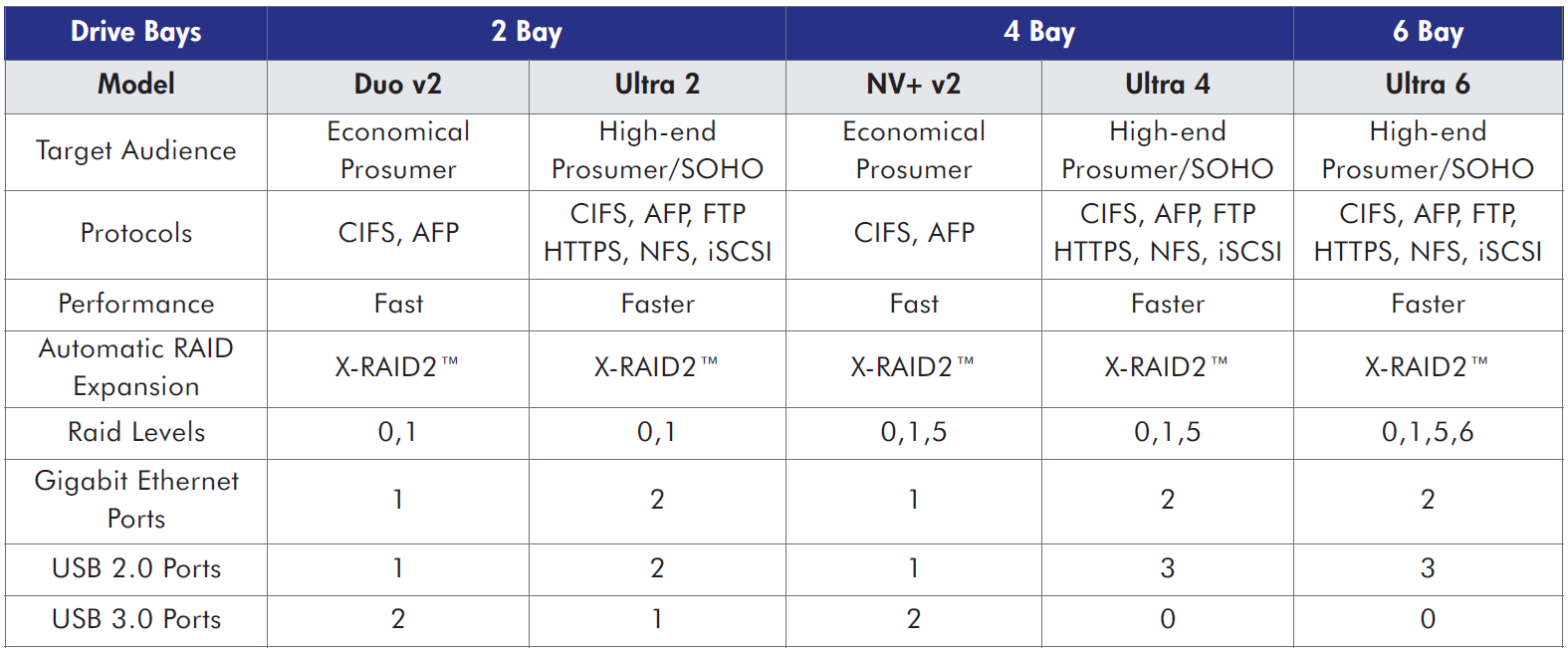
The 2-bay Duo v2 is meant to replace the existing ReadyNAS Duo and the 4-bay NV+ v2 is meant to replace the existing ReadyNAS NV+. Compared to the Ultra and Ultra Plus series, these solutions are much cheaper. They also sacrifice some features such as NFS and iSCSI. These are not used by a majority of the consumers in the economical prosumers segment. Hardware wise, both the products carry only one GbE port (compared to the two ports in the Ultra lineup). The table below presents the various home NAS models from Netgear.

Netgear's suggested pricing for today's introductions is presented below:

Netgear doesn't offer any specifics on the platform except for indicating 'Marvell Smart' in the packaging and a 1.6 GHz CPU at the core. Both the Duo v2 and NV+ v2 run on the same CPU, with the number of bays being the only difference. A look at the pricing table above reveals that the units compete in the same class as that of the LG N2A2 NAS that we reviewed a couple of months ago. Is the platform same? How does the performance stack up? We will see the answers to these questions in the next few sections.